
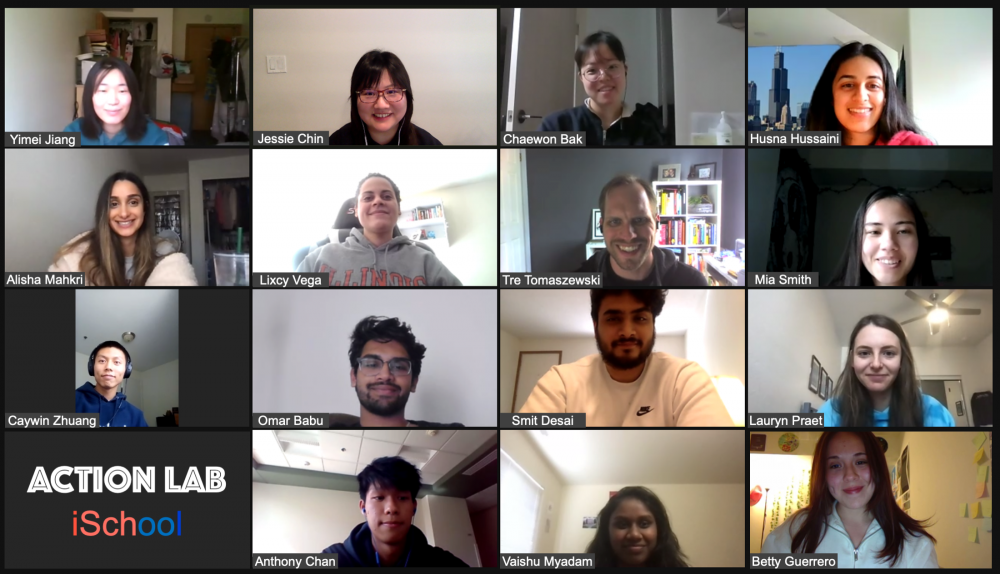
The research program aims at advancing basic knowledge in cognitive sciences about how human minds adapt to contemporary information environments through self-regulated processes, such as information search and uptake, for complex information goals, including decision-making and knowledge acquisition.
[NOTE] Graduate students with interests in cognitive science and human-computer interaction, feel free to contact chin5@illinois.edu with your CV.
Ongoing Projects
-
(Individual and Collective) Foraging for learning new knowledge in the wild
- Current student: Yimei Jiang
-
Evidence identifying and foraging in domain-specific decision-making (medical and judgment systems)
- Current student: Michelle Bak, Julisa Salgado
-
[Funded] Examine the dynamics between enrichment seeking and cognitive/socioemotional well-being among the adults in their midlife and older ages
- Current student: Smit Desai
- The Fireside Exploration Project
- Funded by Napoleon Fireplaces
- MPI: Shannon Mejia (College of Applied Health Sciences)
- Research Output:
- Chin, J., Mejía, S., Desai, S., Washington, F., Ramesh, D., Deshpande, F., & Dash, S. (November, 2022). The effects of environment-induced relaxation on cognitive foraging under stress in midlife and beyond. Late breaking poster presentation at the annual scientific meeting of the Gerontological Society of America (GSA) 2022, Indianapolis, IN.
- Mejía, S., Chin, J., Washington, F., Desai, S., Ramesh, D., Deshpande, F., & Hong, S. (November, 2022). Relaxation elements within a home environment and older adults’ socioemotional experiences of challenging tasks. Late breaking poster presentation at the annual scientific meeting of the Gerontological Society of America (GSA) 2022, Indianapolis, IN.
-
Iterative Information Search and Exchange for Small Groups
- Current students: Eesha Chawhan (Alumni: Yu-Wei Lai, Jacky Chen)
-
Developing Educational Games for Misinformation Verification
- Current students: Philo Wang, Kelly Dai
Completed Projects and Selected Publications
-
Information foraging across the lifespan
Chin, J. & Stine-Morrow, E. A. L. (2016). What makes you feel you are learning: Cues to self-regulated learning. In A. Papafragou, D. Grodner, D. Mirman, J. C. Trueswell (Eds.), Proceedings of the 38th Annual Conference of the Cognitive Science Society(pp. 538-543). Austin, TX: Cognitive Science Society.
Liu, X., Chin, J., Payne, B. R., Fu, W-T., Morrow, D. G., Stine-Morrow, E. A. L. (2016). Adult age differences in information foraging in an interactive reading environment. Psychology and Aging, 31(3), 211-223. DOI: 10.1037/pag0000079
Chin, J., Payne, B., Fu, W-T., Morrow, D. G. & Stine-Morrow, E. A. L. (2015). Information foraging across the life span: Search and switch in unknown patches. Topics in Cognitive Science, 7(3), 428-450. DOI:10.1111/tops.12147