
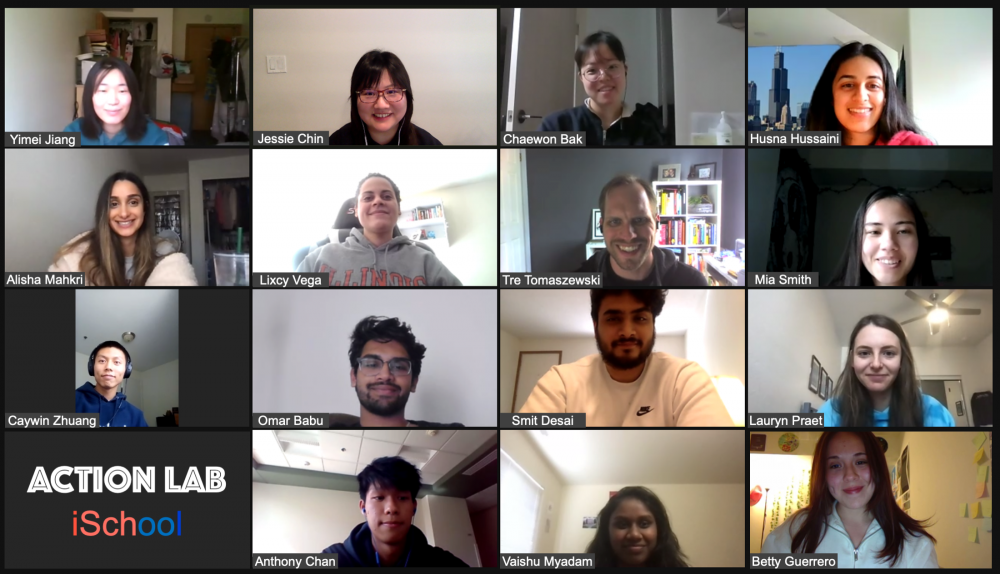

The research program aims at translating theories in cognitive psychology, human-computer interaction and machine learning to design information technologies that support complex cognitive processes (such as decision-making and learning) for adults across the lifespan.
Ongoing Projects
-
Designing instructional conversational agents for older adults
- Current student: Smit Desai
-
AI-assisted agents in informal/self-regulated learning
-
- Current students: Smit Desai, Morgan Lundy
-
-
Combing learning theories and machine-learning to design interactive learning interfaces
- Current Student: Tre Tomaszewski
-
Search for learning: Building intelligent learning agent
- Current Students: Tre Tomaszewski
-
Making health decisions with AI agents
- Current Student: Caywin Zhuang
Selected Publications
Desai, S. & Chin, J. (2020). An explorative analysis of the feasibility of implementing metacognitive strategies in self-regulated learning with the conversational agents. In Proceedings of the 64th International Annual Meeting of the Human Factors and Ergonomics Society.
Chin, J.*, & Desai, S*. (2021, November). Being a Nice Partner: The Effects of Age and Interaction Types on the Perceived Social Abilities of Conversational Agents. In TMS Proceedings 2021.
Desai, S., & Chin, J. (2021, July). Hey Google, Can You Help Me Learn?. In CUI 2021-3rd Conference on Conversational User Interfaces (pp. 1-4).
Desai, S., Chin, J. (2023). OK Google, Let’s Learn: Using Voice User Interfaces for Informal Self- Regulated Learning of Health Topics among Younger and Older Adults. In Proceedings of the 41st ACM Conference on Human Factors in Computing Systems CHI’23 (Article 847, pp.1-21). New York, NY: ACM Press. DOI: /10.1145/3544548.3581507
Completed Projects
-
Designing adaptive interface to support web information search for older adults
Chin, J. & Fu, W-T. (2012). Age differences in exploratory learning from a health information website. In Proceedings of the 30th ACM Conference on Human Factors in Computing Systems CHI’12 (pp. 3031-3040). Austin, TX: ACM Press. DOI:10.1145/2207676.2208715
Chin, J. & Fu, W-T. (2010). Interactive effects of age and interface differences on search strategies and performance. In Proceedings of the 28th ACM Conference on Human Factors in Computing Systems CHI’10 (pp.403-412). Atlanta, GA: ACM Press. DOI: 10.1145/1753326.1753387
Chin, J., Fu, W-T. & Kannampallil, T. (2009). Adaptive information search: Age-dependent interactions between cognitive profiles and strategies. In Proceedings of the 27th ACM Conference on Human Factors in Computing Systems CHI’09 (pp.1683-1692). Boston, MA: ACM Press. DOI: 10.1145/1518701.1518961